Navigating the Chicago Home Closing Process: A Step-by-Step Guide to a Stress-Free Finish
The five days following an accepted offer shouldn't feel like a high-stakes interrogation. It's the moment you've worked so hard for, yet the sudden pressure of the attorney review period and the mystery of hidden fees can quickly drain the joy out of the experience. You deserve to feel like a partner in this transaction, not just another file on a desk. If you've been looking for Chicago home closing process help, you've likely realized that this city's real estate landscape has its own unique rhythm and rules.
We're here to help you master these complexities with expert guidance that prioritizes your safety and your goals above all else. We promise to transform that initial confusion into a clear, predictable path forward where your interests are fiercely protected. This guide provides a step-by-step breakdown of the closing timeline, explains the vital roles of your support team, and shines a light on those often-confusing costs. It's time to replace anxiety with confidence and move toward your new front door with total clarity. Consider this a judgment-free space to get the answers you need for a truly stress-free finish.
Key Takeaways
- Understand why Illinois’ status as an "Attorney State" ensures you have a dedicated legal advocate protecting your investment from the very start.
- Learn how to navigate the high-stakes five-day attorney review period with a clear plan for contract adjustments and inspection negotiations.
- Get professional Chicago home closing process help to decode city-specific transfer taxes and North Shore village requirements before you reach the finish line.
- Master proven strategies for resolving common hurdles like appraisal gaps or inspection "deal-breakers" without losing your peace of mind.
- Walk into your final signing day with confidence, equipped with a comprehensive checklist for your final walkthrough and closing table essentials.
Table of Contents
- Understanding the Chicago Closing Landscape: Why You Need a Conductor
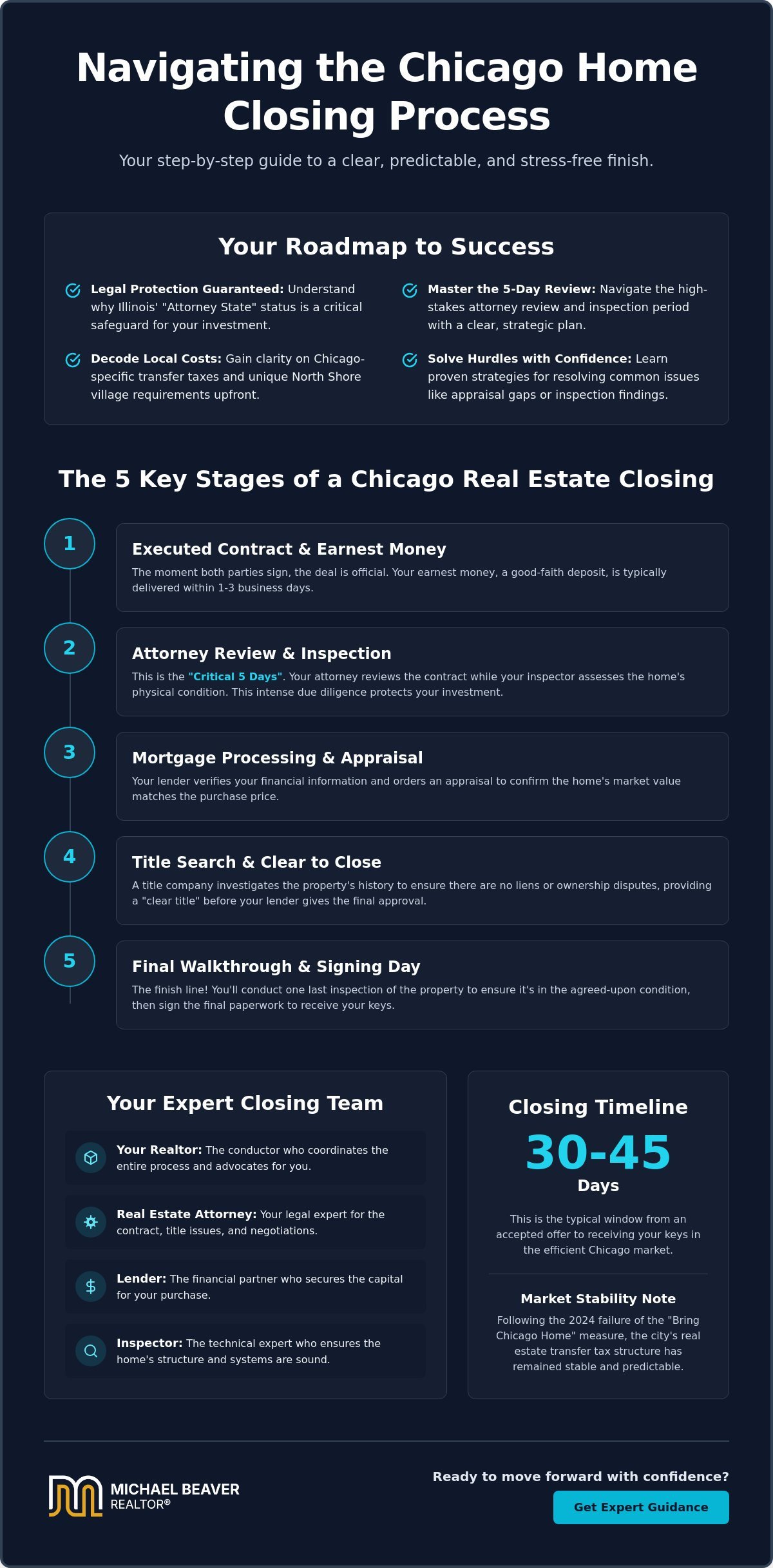
- The 5 Key Stages of a Chicago Real Estate Closing
- Local Nuances: Closing in Chicago vs. the North Shore
- Common Closing Hurdles and How We Solve Them
- The Finish Line: Final Walkthrough and Signing Day
Understanding the Chicago Closing Landscape: Why You Need a Conductor
The closing period isn't just an administrative countdown; it is the most vital phase of your real estate journey. This window officially opens the moment an offer is accepted and stays open until the keys are finally in your hand. In our city, this timeline moves with a unique, purposeful intensity. If you are seeking Chicago home closing process help, you have likely noticed that the pace here feels different. It moves faster than national averages, particularly during the due diligence phase. Decisions that might take weeks elsewhere often happen here in a matter of days. You need a guide who understands this rhythm.
Illinois is what we call an "Attorney State." This means a legal professional is required to oversee the real estate closing process to ensure every document is sound and your interests are protected. This isn't a mere formality. It's a safeguard for your investment. Michael Beaver, REALTOR operates with a philosophy rooted in radical empathy. We believe that high-level business expertise must be paired with a warm, human touch. You aren't just a transaction; you're a person making a life-changing move. We provide a judgment-free environment where no question is too small to ask. We're here to validate your journey while securing your financial future.
The Roles of Your Closing Team
Your Realtor acts as the conductor of this complex symphony. They coordinate every moving part, ensuring that the lender, attorney, and inspector stay in sync. While your Real Estate Attorney handles the critical five-day review period and potential title issues, your Lender and Inspector provide the physical and financial foundation. The inspector ensures the structure is sound, while the lender secures the capital. Expert Chicago home closing process help means having a team that communicates flawlessly so you don't have to repeat yourself to four different people. We advocate for you at every turn.
Setting Realistic Expectations for 2026
As of June 2026, the Chicago market remains efficient and tech-forward. Digital signatures and remote notarization have become the standard, significantly reducing the administrative hurdles that used to slow things down. Most closings currently aim for a 30 to 45-day window. Following the 2024 failure of the "Bring Chicago Home" measure, the transfer tax structure has remained stable, providing a predictable financial landscape for both buyers and sellers. Proactive communication is our primary tool to prevent surprises. We stay ahead of the paperwork so you can stay focused on the excitement of your new front door.
The 5 Key Stages of a Chicago Real Estate Closing
Moving from an accepted offer to the closing table requires a methodical approach that respects both the legal requirements of Illinois law and the emotional weight of your personal journey. It's a sequence of five distinct stages that ensure every financial and physical detail is accounted for. If you've been searching for Chicago home closing process help, understanding these checkpoints is your first step toward a calm, successful move. We see these stages as opportunities to build safety and certainty into your transaction.
- Stage 1: The Executed Contract and Earnest Money. Once both parties sign, you're officially under contract. Your earnest money is typically delivered within one to three business days, signaling your serious intent to the seller.
- Stage 2: The Attorney Review and Inspection. This is the "Critical 5 Days" where the most intense due diligence happens.
- Stage 3: Mortgage Processing and the Appraisal. Your lender takes the lead here, verifying your financials and the home's market value.
- Stage 4: Title Search and Clear to Close. Experts ensure the property's history is clean and free of unexpected liens.
- Stage 5: The Final Walkthrough and Signing. This is the finish line where you verify the home's condition and sign the final paperwork.
The Attorney Review and Inspection Phase
In Chicago, the first five business days after contract execution are vital. This isn't just about legal jargon; it's about making sure your future home isn't a financial burden in disguise. We use inspection results to protect your investment without unnecessarily jeopardizing the deal. An Attorney Modification is a legal tool used by your counsel to propose specific changes to the contract terms or request credits for repairs identified during the inspection period. If you want to feel truly supported during this phase, you can explore our dedicated buyer representation services to see how we advocate for your peace of mind.
The Appraisal and Loan Commitment
Think of the appraisal as the second major hurdle of the closing process. The bank must confirm that the home's value aligns with your offer price. You'll move from "Conditional Approval" to the coveted "Clear to Close" status once your loan officer verifies every piece of your financial history. This Illinois State Bar Association closing guide provides deeper legal context on the documents and roles involved as you approach this milestone. Staying in close contact with your lender during this phase prevents small documentation delays from snowballing into a missed closing date. We're here to help you stay organized and ahead of every deadline.
Local Nuances: Closing in Chicago vs. the North Shore
Where you choose to plant your roots in the Chicagoland area dictates the specific administrative hurdles you will face. A high-rise condo in the Gold Coast requires a different set of keys and certificates than a historic estate in Winnetka. If you are seeking Chicago home closing process help, you must account for these geographic variables early. We've mastered the nuances of both urban condo boards and suburban single-family estates to ensure no detail is overlooked. Your journey is unique, and your guidance should be just as tailored.
In the "Windy City" itself, transfer taxes are a significant consideration. As of June 2026, the total Chicago transfer tax remains a flat $5.25 per $500 of the sale price. This is typically split between the parties; the buyer pays $3.75 per $500, while the seller pays $1.50 per $500. Beyond the taxes, city living involves "hidden" paperwork like zoning certificates and water certificates. The city requires proof that your water bill is paid in full and that the property's use matches its legal zoning before the deed can transfer. These are the small, vital steps where our expertise keeps your timeline on track.
For those looking at financial assistance or clarifying mortgage safety, the Illinois Housing Development Authority FAQs offer excellent state-level context on closing costs. We use these resources to build a foundation of safety for every client we represent.
Condo and HOA Considerations
Buying a condo adds a layer of community governance to your closing. The "22.1 Disclosure" is your most important document here. It reveals the association's financial health, including reserve levels and any upcoming special assessments that could cost you thousands later. We help you review these documents with a critical eye. You should also schedule your move-in date with building management as soon as you have your "Clear to Close" to avoid logistical headaches on day one.
Suburban Village Requirements
Moving to the North Shore introduces village-specific rules that can surprise the unprepared. Communities like Glencoe and Evanston have strict pre-sale inspection requirements that must be satisfied before a closing can occur. In more rural pockets of the North Shore, you may also need to navigate septic or well inspections. Because Cook County property taxes are billed in arrears, we pay close attention to property tax prorations. This ensures the seller credits you fairly for the time they owned the home, protecting your bank account from future tax bills that aren't yours to pay.
Common Closing Hurdles and How We Solve Them
Real estate transactions are rarely a straight line from offer to keys. Unexpected challenges are a normal part of the journey. If you need Chicago home closing process help, you should know that hurdles don't have to be deal-breakers. We operate as a judgment-free zone. No concern is too small to discuss. No question is too basic. We're your dedicated advocates, turning potential roadblocks into manageable steps. We believe your comfort is just as important as the final result.
One common hurdle is the appraisal gap. This happens when the bank values the home lower than your agreed-upon price. We solve this through strategic negotiation. We might ask the seller to lower the price, or we can look for ways to bridge the gap that protect your long-term investment. Title issues, such as old liens or boundary disputes, are another area where we provide expert guidance. We work closely with your attorney to clear these hurdles before they threaten your deadline. We're here to ensure your investment is safe and your path is clear.
Negotiating Credits and Repairs
Negotiation is an art, not a battle. When an inspection reveals issues, you have choices. You can ask for a direct price reduction or a closing cost credit. Often, a credit is better because it keeps more cash in your pocket at the closing table. We ensure all agreed-upon repairs are verified with receipts and professional invoices before you step foot in the final walkthrough. This transparency builds trust and ensures the home is exactly what you expected. We advocate for your interests without unnecessarily jeopardizing the deal.
Handling Financing Delays
Financial hurdles can feel the most stressful. If your "Clear to Close" is delayed by a day or two, don't panic. A delay of 24 hours isn't a failure; it's a pivot. We stay in constant contact with your loan officer to push through bottlenecks. One vital rule: do not make large purchases, like a new car or expensive furniture, before your loan is fully funded. These changes to your credit profile can stop a closing in its tracks. Michael Beaver coordinates directly with lenders to ensure your documentation is prioritized and your timeline stays intact. If you want a partner who can navigate these high-stakes moments with you, contact us for expert buyer representation to get started.
The Finish Line: Final Walkthrough and Signing Day
The final 24 hours of your journey are about verification and celebration. You've navigated the intensity of the attorney review and the high stakes of the appraisal. Now, the finish line is finally here. If you've been relying on professional Chicago home closing process help, this is where that coordination pays off. We shift from legal scrutiny to physical confirmation. You deserve to walk into your new home with total confidence. It's a moment of profound transition, and we're here to ensure it's as joyful as it is secure.
The final walkthrough typically happens the day before or the morning of the closing. This is your opportunity to ensure the property is in the same condition as when you made your offer. We check that all agreed-upon repairs from the inspection phase were completed properly. We test the appliances, run the faucets, and check the HVAC. We make sure no new damage occurred during the seller's move out. This isn't just a walkthrough; it's your final layer of protection before the investment is officially yours. You should also take this time to review your Closing Disclosure (CD) one last time. We double-check every number, from the prorated property taxes to the final loan terms, ensuring everything aligns with your expectations.
The Signing Experience
In Chicago, the actual signing usually takes place at a title company office. It's a professional yet intimate setting where the final transfer of ownership occurs. You'll need to bring a valid government-issued ID and your certified funds, typically in the form of a wire transfer or a cashier's check. You'll also want to bring a celebratory spirit. You'll face a mountain of paperwork, including the mortgage note, the deed, and various disclosures. Don't let the volume of documents intimidate you. Your attorney and your conductor are there to explain every page in plain English. Most signing appointments take about 60 to 90 minutes. Once the lender confirms the funding and the documents are recorded, the keys are yours. It's a life-changing moment.
Post-Closing Support and Advocacy
Our partnership doesn't end when the ink dries. Settling into a new neighborhood like the North Shore or a vibrant Chicago community requires its own set of steps. You'll need to transfer utilities and change the locks immediately. We provide a "Conductor's Guide" to help you navigate these local logistics smoothly, from finding the right waste management service to understanding local parking permits. We remain your advocate long after moving day. Whether you have "dumb" questions about your first property tax bill or need a trusted contractor recommendation, we're here. We prioritize the person behind the transaction, and that commitment stays firm long after you've unpacked your first box.
Ready for a seamless transition? Contact Michael Beaver for expert representation.
Your Path to a Confident Closing
You've moved through the complexities of the Chicago real estate landscape, from the initial intensity of the attorney review to the final verification of your walkthrough. Mastering this timeline isn't just about managing paperwork; it's about protecting your investment and your peace of mind. By understanding the local nuances of city transfer taxes and suburban village requirements, you've already taken the most important step toward a successful move. If you've been looking for Chicago home closing process help, you now have the roadmap to navigate every hurdle with total clarity.
As a dedicated advocate with specialized knowledge of both North Shore estates and Chicago condos, I bring a unique blend of radical empathy and high-level expertise to your transaction. My affiliation with Baird & Warner, a firm established in 1855, provides a foundation of stability that has supported families for generations. As an Expert Real Estate Negotiator, I'm here to ensure that every appraisal gap or inspection hurdle is handled with precision and care. You deserve a partner who values your comfort as much as the final result.
You don't have to navigate this journey alone. We're here to provide a judgment-free space where your goals are the only priority. Let Michael Beaver guide you home-Schedule your consultation today. Your new front door is closer than you think, and we're honored to help you open it.
Frequently Asked Questions
How long does the home closing process typically take in Chicago?
The closing process typically takes between 30 and 45 days from the moment your offer is accepted. This timeline accounts for the five-day attorney review, the home inspection, and the lender’s appraisal process. If you are a cash buyer, this window can often be shortened because you aren't waiting for a bank’s final loan approval. We help you stay organized so every deadline is met with ease and confidence.
What are the average closing costs for a buyer in Chicago?
Buyers in Chicago should budget for closing costs ranging from 2% to 5% of the home's purchase price. For a $400,000 home, this typically falls between $5,500 and $8,000. These costs include your portion of the city transfer tax, recording fees, and lender origination charges. We provide a judgment-free environment to discuss these numbers so you feel financially prepared long before you reach the signing table.
Can I back out of a contract during the attorney review period?
Yes, you can back out of a contract during the five-business-day attorney review period for almost any reason without penalty. This period is designed to be a safe harbor for you. It allows your legal counsel to ensure the contract terms are fair and that the property's condition meets your standards after the inspection. It's a vital phase where your interests and your earnest money are strictly protected.
What is the "Clear to Close" and when does it happen?
The "Clear to Close" is the final green light from your lender confirming that all conditions for your loan have been met. It typically happens three to five days before your actual closing date. Once you receive this status, your interest rate is locked and your final numbers are settled. It is a rewarding moment in the journey because it means your move is officially confirmed and secure.
Do I need to be physically present for my Chicago home closing?
You don't always need to be physically present if you arrange for a Power of Attorney or utilize remote notarization services. By June 2026, digital closing options have become much more common and streamlined in Illinois. However, many buyers still prefer to attend in person to sign the final documents and receive their keys immediately. We support whichever method makes you feel most comfortable and safe during the transition.
What happens to my earnest money if the deal falls through?
Your earnest money is generally returned to you if the deal falls through during a protected contingency period. This includes the attorney review, the inspection phase, or if you fail to secure a mortgage. We advocate for your interests to ensure your deposit is handled correctly throughout these critical checkpoints. If you need Chicago home closing process help to understand your specific contract protections, we are here to provide total clarity.
How does the Chicago transfer tax work for buyers?
The Chicago transfer tax for buyers is currently $3.75 for every $500 of the property's sale price. This is a standard city requirement that is paid at the closing table as part of your final settlement. If you need Chicago home closing process help to calculate these city-specific fees, we can provide a detailed estimate based on your offer price. This ensures there are no financial surprises when you go to sign your deed.
What is a 22.1 disclosure in a Chicago condo sale?
A 22.1 disclosure is a mandatory document in Chicago condo sales that details the financial and legal health of the homeowners association. It lists the association's reserve funds, any pending lawsuits, and upcoming special assessments that might affect your monthly costs. Reviewing this document is a vital part of our process to ensure you aren't walking into a financial surprise. We help you decode these reports so you can buy with confidence.